Full Master Journal Edition · 30 min read · Audited references, empirical data tables, and complete organizational architecture. Looking for the high-level synthesis?
Switch to Executive Brief (7 min read).
Executive Abstract
Culture is a reflection of who a company is, and many companies are on their way to a culture built around AI. This paper argues for a different anchor. The context of the business (the why behind the what: why things are the way they are, what the numbers mean, who decided what and why) is fragmented across most organizations, rarely written down, and about to be lost as AI absorbs the work through which people once learned it. Context does not replace culture; it is the anchor around which a culture forms. Retaining it takes deliberate, continuing work, and it may be one of the best ways for an executive team to prepare for AI. The paper traces what is being lost, describes how context moves between people, and sets out what an executive team can do this quarter.
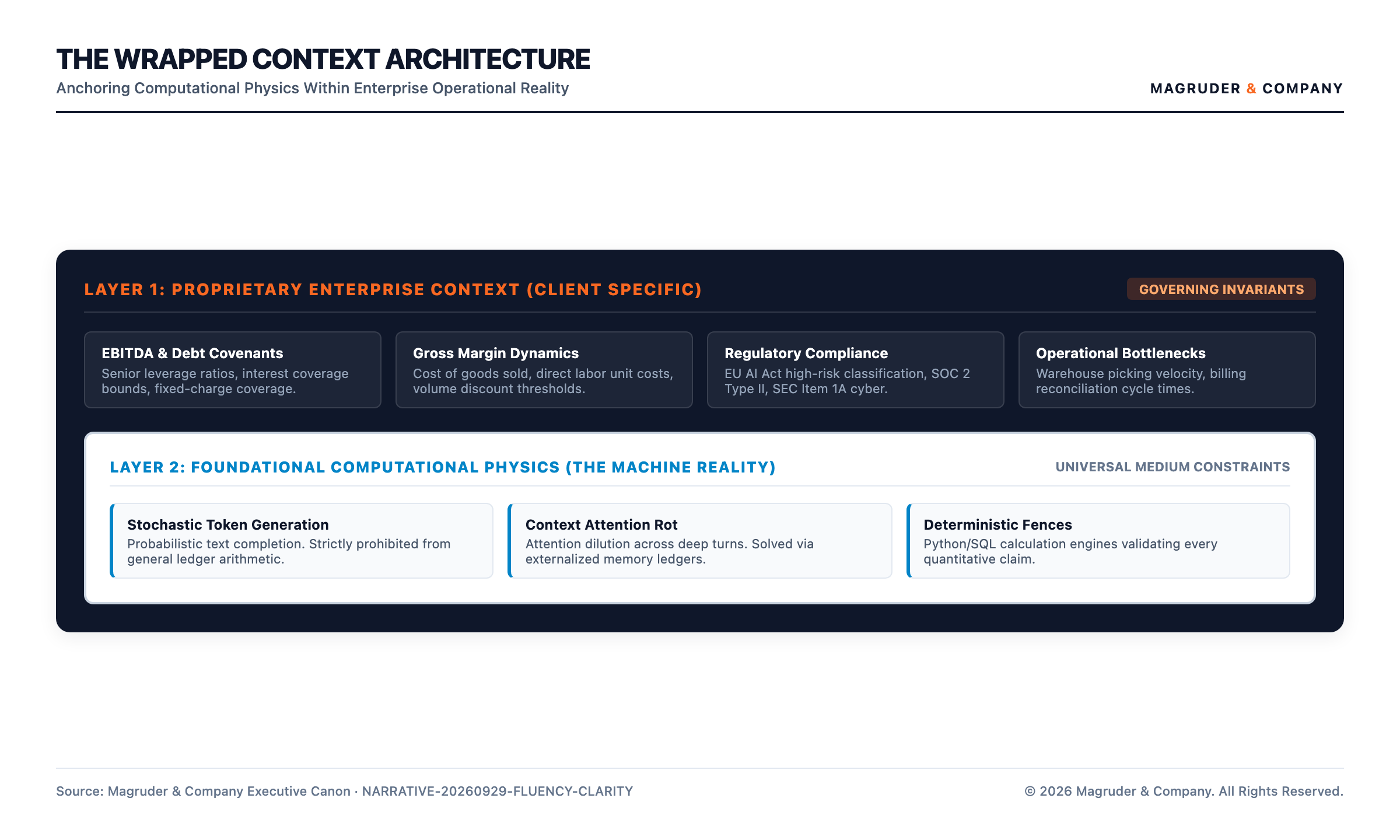
Exhibit 1: The Context Architecture: Anchoring Enterprise Reasoning Along Value Streams Across Functional Disciplines.
We Cannot Let AI Become Our Culture
Culture is a reflection of who a company is: how it does things, what it values, where its focus goes. Right now, many of us are on our way to a new one. We talk about AI, we breathe it, it is the problem and it is the help, and it is becoming the subject of nearly every conversation we have, rather than capturing and curating the context of the company, the customer, and the market. Instead, we throw AI at it. I have done it. I have seen others do it. We are buying products that do it. And in the end it still comes back to the same things we have to understand, and I do not see us capturing them. We cannot allow AI to become our culture.
What is truly a company's own is not the tool, and not the metrics each function reports about itself. It is its deep understanding of why it does what it does: its customers, its market, its products, and the reasons behind its processes, even as those processes change. That understanding is what I mean by context. Not context about AI, about workflow, or about savings, but the why behind the what: why a process exists, what a number is actually measuring, who decided something and why, and which parts of the business are load-bearing and which are simply old.
It lives in people, across every function and level, and it is formed between them: in the room, in the argument, in the exception someone remembers from three years ago. When a seasoned person looks at something and says "that just doesn't feel right," that feeling is context at work. Much of it is not written down, and it is about to be lost, as AI absorbs the work through which people used to learn it. Once it is gone, it is remarkably hard to recover. In my work with executives, this is one of the largest gaps I see, and one of the least discussed.
Right now, the priority is AI itself: agents, automated workflows, and the platforms that promise both. The assumption underneath is that context comes along for the ride: if the tools are good enough, the understanding will follow. In my experience, it does not. I have spent the past year living this. Retaining context takes significant, deliberate work. It has to be curated, assimilated, codified, and institutionalized, and not once, but continuously, as the work happens. That is not a knowledge management platform. It is a discipline, and almost no one is practicing it.
Context does not replace culture. Trust, identity, and shared norms are what make a culture, and nothing formal substitutes for them. As MIT Sloan's Edgar Schein showed, culture forms around what leaders pay attention to, measure, and reward [11]. We measure adoption, so adoption becomes the culture. A culture needs something better to form around, and context is the anchor: the layer through which a company's intent reaches its work. The context creates collaboration that improves the culture. It needs to become so much a part of our organizations' DNA, across the entire enterprise, that it becomes the culture that holds a company together and keeps its best people.
That cannot be a project. It has to be the stated position of the executive leadership team, because context is fragmented across an organization the same way its people are. Most people do not know what the people around them do. We know far more about our functional disciplines than about the actual work moving through our value streams, the end-to-end flows of work that reach the customer. The value streams are where context matters most.
Context anchors teams, especially along the value chain and across functional disciplines, in a way a RACI chart never can and a reorganization never will. Most of us as executives still talk in terms of org charts and functional disciplines, because the P&L is structured that way, and changing it would feel enormously disruptive. So we call ourselves highly matrixed, or we draw RACI charts. When that does not work, we reorganize, cut roles, and define new ones. Often a reorganization is itself a symptom of missing context: we move the boxes because we do not understand the work between them. It is like telling a child to eat the vegetables on the plate. The child pushes the food around until it looks different. It distracts us, and because we are not looking closely, we miss that the same amount of food is still on the plate. Context is a win for nearly everyone at the table: for HR, for operations, for finance, for every functional discipline, and for earnings quality. It is part of the security of the company, and it is the company's intellectual property.
There is a window. The people who hold that context are still here, and AI has not yet absorbed every workflow. Focusing on context now may be one of the best ways for an executive team to prepare for AI. Next year's plans are being set now. An executive team that does not prepare a position on context this quarter, at the heart of its position on AI, and plan for it in next year's work, may find that by the time it turns to the question, much of the context is already gone.
Part I. What We Are Losing
The Relay
Here is the relay as I see it. One group's job is to pull data and content from its sources and put it into a deck. A larger group gathers, and the first group presents to them. The presenters use AI to package the content. The audience uses AI to receive it and act on it. Each person in the audience then uses it for different reasons and takes different context from it, none of which is written down anywhere the organization can use. Then it moves on to wherever decisions are made.
The relay is usually counted as wasted effort, and the hours are easy to recognize. If ten people attend a one-hour meeting, that is ten hours, and whoever built the presentation has spent hours on it as well; a single internal presentation can cost five, ten, even twenty hours. People can tell when a presentation was built with AI, and they are beginning to check out. They still have to attend.
That is the smaller loss. The larger loss is on the receiving end. Every audience forms its own context from the same artifact, for its own purposes, and that context is never captured. It travels by memory into the next room and the next decision, where it arrives in fragments. AI on both ends of the relay speeds up the packaging and the receiving; it does nothing to keep the meaning formed in between. Organizations that miss this find that AI multiplies the confusion they already have, at machine speed.
One recent account shows the same pattern at the scale of a whole transformation. In a two-year turnaround across eight divisions and more than 3,000 employees, a central transformation office of more than 15 people spent more than half its time validating data and rerunning spreadsheet analyses to produce a report of more than 300 pages every four weeks for a two-day board workshop [1]. Agents can now draft that deck, tailor it for every workstream lead, and make sure the right owner is invited to the review. In one deployment, automating ten core insight-generation and reporting processes took the central team from an engagement manager and nine staff to the manager and two. Read through the lens of context, that is the relay made faster and more consistent. A single source of truth settles the number. It does not settle what the number means to the people who have to act on it. What decides the outcome is trust. As the authors note, the model works only if the team understands, trusts, and believes in it, and AI cannot replace the creative nuance of organizational culture [1].
If information is useful in one place, it can be used in another. The people in between do not need to be fired. They need to be elevated, so they can map the content and the context around it, not just the workflow, and carry it to where decisions are made. They hold some of the most transferable work in the enterprise. Then their work becomes conversations about context, with their heads up instead of down. What could you do with twenty hours? The context people could build in that time also builds relationships, in an age when nearly everything is passed along digitally. Imagine people coming back together, heads up, having a deeper conversation instead of simply presenting material. One group says where the information lives. The other says how it is used over there.
The Apprenticeship in Context, for Everyone
The work most companies are automating first is the work that taught their people what the numbers mean. Building the deck, reconciling the figures that disagreed, being asked in the room why a number moved: it is easy to see that work as grind, as tasks. But it was also training. Inside it was an apprenticeship in context: the depth to understand what the numbers mean. That is how people learned who decides what, which numbers matter, and why the business works the way it does.
If we do not have a purposeful direction for our people, and we start throwing AI at automating workflow, who is training them? What happens to the knowledge and context inside the company? The company may book short-term wins and long-term failures, and by then the executives who made the call have often moved on. The rest of the employees are left with the result: a generation that is less trained, more dependent on AI, less contextually connected, and more remote than in-person.
"AI didn't create this. As leaders and executives, we created it."
This is not only about early-career people, and it is not only about Gen Z. Every member of a company, from a new teammate to a director to an executive, has to be contextually trained. Human reasoning, and the gut feel that tells you something is wrong, both rest on deep contextual knowledge. If we cut context out everywhere in the name of speed, where does anyone's context training come from?
It does not have to be rebuilt the old way. A living, governed body of the company's knowledge may teach context faster and better than the relay ever did, but only if someone deliberately builds it. The deliberate replacement also keeps context-forming work human for people early in their careers, with AI as a tutor rather than a substitute, and has leaders coach directors and vice presidents in decision practice, not only in execution.
Verification Debt
There is a second cost, and almost no one is describing it. I have lived it for the past year.
AI can produce a synthesis in minutes, even seconds. Proving it is right can take as long as building it did the old way. Auditing, repairing, reframing, and recontextualizing the output can consume all of the time it saved. I call this verification debt: output produced faster than anyone can confirm it. It accumulates alongside two debts most companies already carry: task debt, the load of tasks that keeps landing on people who are expected to relieve it by building their own automations, and workflow debt, the legacy processes no one has retired.
Many times the debt is never paid at all. The output is never checked or reviewed, and the error surfaces later, in something that does real damage. By then no one can trace where it began, because there is no provenance. We like to believe our systems hold our content like a verbatim database. Most content is not saved that way. Even in some of the most sophisticated systems I have seen, information does not carry full provenance: where it came from, why it is there, and what it is worth. Finding the origin of an error can take days or weeks, if it can be found at all. We are going after automation in a way that helps in the short term, while the downstream impact is not seen.
Three properties of these systems make the debt grow. The first draft becomes the truth: once output exists, people modify it rather than question it, and an error made in seconds can survive long after anyone remembers where it came from. The systems are pulled toward finishing, not toward accuracy: large language models are probabilistic, and they move toward a finished answer, which is not necessarily an accurate or fluent one. And context drifts: long work is compressed as it goes, details drift, and the systems can hallucinate, however powerful the tools are.
None of this is an argument against the tools. I use them every day. It is an argument that the cost of trusting them has to be counted, and that someone has to be trained to pay it. A board can ask for two numbers: the hours spent correcting AI output, and how long it takes to trace an error to its source.
Complexity Is Not Sophistication
Much of what we are trimming in the name of AI is not sophisticated. It is complex, and the complexity has never been reasoned through. When we unplug a process to streamline it, there may be something in it that needs to be there, something quietly holding the business together that no one wrote down.
That complexity is itself a signal to stop and reason before cutting, and a marker that people trained to stand between AI and the decision are needed. So is the moment someone who knows the work looks at a change and says it does not feel right. Both signals are only available to people who carry the context. Strip the context out, and the signals disappear with it.
The most visible corporate AI experiment of the period shows the cost. In early 2024, Klarna introduced an AI customer service assistant that reportedly did the work of 700 full-time representatives. Its workforce fell by roughly 40 percent between December 2022 and December 2024. In May 2025, its chief executive acknowledged that the company had focused too much on efficiency, that quality had suffered, and that it was rehiring people and moving to a hybrid model [2]. In my reading, automating without the context of what the work was really doing can turn operating savings into customer and brand costs.
No One Bears the Context
Who is bearing the context of the company? What we often do not realize is that there is no context bearer: no one who holds the company's context and owns it. Nor is anyone at the top clearly its advocate. We have a chief marketing officer, a chief human resources officer, a chief technology or information officer, and each is dealing with deep and sophisticated problems. But none of these roles is necessarily charged with the business context of the organization, and that work has to be done before anything is built on top of it. Today it happens ad hoc: along the way, when another project is underway, or when a system is implemented and things have to be cut over.
The answer is not a new department. Part of every role, from the newest analyst to the chief executive, is to bear the context of the work and to do something with it: carry it up to where decisions are made, write down why things are the way they are, question a decision when something does not feel right. Every role bears it, and no one owns it alone. The work of capturing it needs a home, whether a small dedicated office or part of an existing one. What is missing today is the acknowledgment that bearing context is part of the job, and a place for what is borne to go. So context stays fragmented, and it leaves when people do.
The symptom shows up at the top. One of the biggest examples I run across in consulting is that executives and their direct reports often make decisions without the deeper context for why things are the way they are. Because of their roles, they are rarely questioned, and their reasoning is rarely audited. That is especially true when leaders come in from outside the organization, and there is no mechanism for finding out what they do not know and what others in the company do know. In my observation, executives are becoming more transient, while the people reporting to them hold the deeper context but lack the decision practice of tenured leaders. I am not seeing vice presidents and directors coached in the deeper contextual understanding the business needs. Decision rights now tend to sit where context is thinnest.
So the work flows downstream, and plenty of people downstream can see it: "Hold on, we don't need to be doing that." They have the context. They do not have a way to be heard. There is no mechanism for the known unknowns. My concern is that we are not choosing well even now, and we are adding AI on top. AI accelerates the production of options and artifacts. It does not improve a choice made without context.
Heads Down
I believe the remote culture we accelerated during COVID had already thinned this before AI arrived. There is no water cooler. As much as we would like to believe a video call is the same, it is not the same as being in a room, wrestling through problems, with the challenges and frictions that make understanding stick. Remote work is episodic, and we rarely spend the time inside those meetings to understand the deeper context.
AI makes us more effective, and it also keeps our heads tilted down: into the tasks, into the workflow, into learning AI and learning automation. A growing share of our thinking is expressed not to people but to AI. These models listen extremely well. They affirm us. They give us a feeling of being understood. We are wrestling less with each other, and we are growing less with each other.
The commentary does not help. Change in AI is coming faster than anyone can process it, and the experts I follow struggle to report on it and give it context. On LinkedIn, and inside our own companies, there is a talking class of people who simply talk about it. Most of that commentary speaks to the pathology. As leaders, we need to speak to the hope in the context of the pathology. I hold this as an observation, not a verdict: even my own attention is pulled the same way, testing a governed body of research of 1,200 pages, reduced from over 3,000 pages, so that it does not fail, drift, or hallucinate.
Both things are true, though. Remote work is one cause of the cultural problem, and it also loosens the old structure: people working remotely already sit loosely in their functional silos and are available to be realigned around the value streams. Leaders who take that structural benefit owe a deliberate replacement for what proximity provided: designated in-person time, explicit coaching in decision practice, and context that is captured rather than overheard.
So the question for every executive team is what it has in place to establish, or re-establish, an anchor for its culture. This paper's answer is context.
Part II. How Context Moves
Upline Context Culture
Executives still own the decision. But the people closest to the work should research the issue, define it, refine the recommendation, and write out the reasoning, with a mechanism that guarantees an answer, so nothing sits on an executive's desk. Then the executive's job is to ask good questions of the reasoning and decide. I call this upline context culture: reasoning and context move up from the teams closest to the work, rather than work being pushed down as simple tasks to complete.
What makes it work is a mechanism, not goodwill, and it separates two things. Every recommendation receives a written answer, with the reasoning. The work that follows goes into a queue everyone can see, with its status and next step, without a promised completion date. Shared context does not mean agreement: it lets people disagree with better understanding, and the executive still decides. That is what gives the people downstream a sanctioned way to say "hold on" before a decision made without context becomes work.
The Interlock: People Reasoning Together
Why keep presentations whose only job is to transfer information, when the same people could be in one room, understanding together what is coming, deciding what to modify and what to remove, adding what they learn to the organization's living body of knowledge, and being rewarded for it?
That needs a structure for the people: a regular working session, weekly or whatever fits, where a cross-functional group within a value stream assesses the work together, as a review panel, so AI is not doing it alone. The danger of individuals quietly making these connections on their own is that no one else provides oversight and accountability. The interlock is where people across functional disciplines reason through things together, as people, and where the work they hand on is taken up.
Standing Between AI and the Decision
Organizations are investing in the tools and not in the people who stand between the tools and the decisions: people trained to direct AI, verify what it produces, and keep its output tied to what the business actually knows (human-to-AI intermediation). Most executive teams do not yet know this skill has to exist.
I know how demanding it is, because I practice it every day. To get work I can trust, I sometimes run four different models against one another, each checking and taking apart the others' work, over many passes back and forth, not one. As much as I would like a single model to do the work, I have spent as much as 90 percent of a day on governance that turned out not to be enforceable, or that I was led to believe was enforceable and was not. I have advanced it far enough to apply it to my own work daily, with the right oversight at the right time. It still has to be stewarded, continually.
"If you are not trained in what to look for, you will miss it."
That is my concern: an entire generation, and an entire stretch of time, in which we do not fully understand this.
Inside a company, the skill needs a home. Once people have agreed on the context and know what to remove and what to keep, there probably needs to be a small, dedicated office, or a place within an existing one, trained in human-to-AI intermediation, to which they can hand the remaining work. That office assigns the build, records each use case, and keeps the work governed, so people can return their attention to the business instead of each maintaining their own automations. Work on automation and workflow is assessed, recorded, and verified before anyone claims success, so no one can overstate it; the loudest voice should not win. Verified successes are then reported upward and amplified, with credit to the people who did the contextual work. What gets handed to that office goes into a queue everyone can see. There does not have to be a deadline. People can see whether anything has happened and what comes next, and they can help or feed it what it needs. That creates collaboration.
Heads Up and Human Affirmation
The hope for heads down is to lift our heads. Address context across the value stream, and cut out what should be removed rather than automate it. Retire legacy processes as a mandate from the executive team, so no one carries workflow debt. Then communication happens at a higher level, with people speaking to each other instead of looking down and performing the automated task themselves.
Executive teams have an opportunity to anchor culture in human affirmation instead of AI affirmation. AI will always affirm people. Executives need a mechanism to listen and to affirm, including when what they hear is not comfortable: to listen to the people making deeper contextual decisions, and reward them. Reward them for cutting task debt. Reward them for working together across functions within the value stream, and for reaching agreement or disagreeing with reasons. Highlight people for how well they work with each other on context, and show how it improves the company, through lower cost or a stronger value chain.
When people look down, asking AI instead of each other, they stay heads down. They have to look up to talk to each other, and that needs to be rewarded, because it builds the connective tissue only people can build with each other. Workflow never goes away, but if people reason at a higher level, some tasks stop existing, and the workflow stops running through so many hands. That frees people to grow, to develop their careers, to want to stay, and to curate the context around everything they do so it can be assimilated, codified, and institutionalized.
Part III. What an Executive Team Does This Quarter
Plant the Flag
Every executive team needs to plant a flag and say: this is our position on AI. Not a policy so much as a position, a short set of commitments everyone knows and can repeat. And most of it should be about context: the position on AI is, at its heart, a position on context about the company itself and the information needed to run it.
Context also has to be modeled. Too often, in a keynote or a message to employees, a leader reaches for an outside example: one of the largest companies in the world, a company most of the audience will never become. What that tells me is that the leader does not yet know the organization's own context well enough to find the stories that are meaningful to everyone in it. Those stories exist in most companies. There are examples inside the business that speak to every functional discipline without ever mentioning another company. An executive who tells them shows people their own enterprise, and context lifts their heads. Context connects, and what is connected is what people remember and use; over time, that connection becomes a shared language across the organization, and people become fluent in it. We have to become fluent in context.
The position does not need to slow anything down. Many fast decisions do not need to be slowed. They need to be framed, and governed a little, inside the executive team. Bring people in, internally rather than externally, quickly and effectively. The position comes first; the full governance and policies can be built out after it. Much of it carries from one company to the next, and some of it is specific to yours. These are big-ticket organizational and operational items, not the weeds. It does not need to overcommit. It needs to be clear enough, and fluent enough in the subject, that your people trust you.
It sounds something like this. If you are in a meeting and see a way to connect one point to the next and save a lot of time, do not worry that it will cost someone their job; no one will be fired for bridging one point to the next. We are going to elevate everyone to start speaking in context, and we will assign people to help manage the workflow. If we do not have enough help, we will figure it out. We need your head up, looking at the market, the customer, and the product. We need your human insight and your human attention. You have the deepest insight and context in the company, and we do not know all of it; we have not even captured it yet. We want to build a culture of context, and we want to invest in you, not just in AI.
The commitment is scoped to retiring relay work, to bridging one point to the next. It is not a promise that no role will ever change. Where capacity is released, the honest order is to elevate and redeploy first, absorb through attrition second, and reduce third, and to keep a visible record of all three. A blanket promise is not credible to boards or to employees; a visible record is.
"You do not work for AI. You do not serve AI."
Do not bow down to AI and serve it as if it were a god. It is a tool. Stay heads down in it too long and you end up serving it: it consumes your time and leads you down paths you did not mean to take. We need people doing the work of the business, not tasking, and there are people inside the company to talk to about it.
Where I Fit, and the Next Generation
When people can see a map of how everything connects, they can say: that is where I fit. I am not the team lead of something or the manager of something. I do this, and it contributes to the value stream in this way. It stops being a job title. It becomes the feeling of coming to work every day and contributing: knowing where you contribute, how it moves the value stream, and where it shows up in the financials and in the quality of earnings. Everything gets mapped in deep context.
The people who most need to see that map are the ones who fear there will be no place on it for them. Younger employees fear they will not have a job. It is our role as executives to resolve that, and to give a path to the people who dig in, understand the company more deeply, and broaden their context. They could be phenomenal thinkers, but there has to be an environment for them, and it is the executives' job to make sure it exists. A position like this one could do a great deal to ease that fear. Otherwise we keep paying for it: the people we already hired leave sooner, HR carries more of the load, and the work drifts further toward task-driven AI output. In Gallup's 2026 study of Gen Z, 80 percent of 14- to 29-year-olds said AI tools are likely to make it more difficult for them to learn [3]. But the gap is wider than one generation. Anyone who is not trained in what to look for, at any level, will miss what AI gets wrong. The context training has to reach everyone.
Eliminate Before You Automate
Do not automate a relay after the constraint that justified it has disappeared. For decades, companies built cross-departmental relays (slides, status meetings, spreadsheets, approval handoffs) because their systems could not share context. Those relays were rational workarounds in their time. Automating them makes the relay faster without asking whether it should exist at all. Michael Hammer made the case in 1990: stop paving the cowpaths, and use information technology to redesign the work rather than automate it [4]. Researchers now have a name for the output of the automated relay, "workslop": AI-generated work that looks polished and does not move the task forward [5].
Eliminating work is an executive act. Frontline teams are often the first to see obsolete routines, but because compensation, budgets, and daily habits are tied to legacy processes, they rarely hold the authority or the risk tolerance to retire them. Frontline teams find the obsolete work, and leaders, with authority across boundaries, retire it. Frontline discovery stays essential, because the people doing the work see exceptions, risks, and hidden dependencies that executives cannot.
The useful question is why a task exists. Work that only translates information across departmental walls can often go where shared context connects both sides, unless it performs a legally required segregation of duties. Status decks and briefings that only move information up a hierarchy can go where the state of the work is visible. Not every meeting is relay: keep and redesign the meetings that form commitment, confer legitimacy, surface resistance, or resolve ambiguity, because that is where sensemaking happens [6], and it is often where context is formed. What remains, if it is irreducible, creates value, or is required for control, is worth automating within explicit limits, with people in charge and nothing reaching production without accountable human approval. Eliminate a task when its business necessity has disappeared, not merely when its output can be automated.
Tell the Time
In my experience, what limits the value a company gets from AI is more often how the organization is built than which models it can use. Executives do not need to know how the watch works. They need to be able to tell the time and make decisions. Yet we keep being told how the clock is broken, how the watch is changing, and the specifics inside the watch. Executives need those things at a contextual level, so they can decide while keeping an executive perspective, and that is rarely done well for them. The work has three parts: help an executive tell the time, prove that it is the correct time, and give the executive the watch. Giving the executive the watch means the enterprise owns its governed body of knowledge rather than renting someone else's. Telling the time means being in the business, not in the mechanics: where the business lives and makes its decisions.
The division of labor is simple to say. AI observes and executes bounded work without fatigue. Accountable leaders make the decisions and set the limits within which AI works. People decide what work should exist, AI does the work that remains, and results are verified before anyone claims them.
A Living, Governed Body of the Company's Knowledge
I do not think there is a single system on the market that holds a living body of a company's knowledge: one that changes as the company changes, and that keeps the context in which each piece of information originated, why it is there, what it is worth, and its provenance as far back as it needs to go. I had to build governance systems of my own to keep a living body of content governed, because I had not found one that did. In many organizations, the gap becomes visible quickly.
Many executives will say they already capture everything: every meeting is transcribed, the wiki exists, enterprise search reaches every email. Those are artifacts. A knowledge base stores source material. The context worth keeping is what people formed when they used it, formed in many places at once, so the problem is capture, not storage; and what is stored seldom carries provenance. Captured context looks different from a transcript. It is a short record of a decision: who made it, the situation that prompted it, what it was meant to protect, and when it should be revisited.
The research behind this paper became its own example. For the past year I have been taking apart the research on AI from McKinsey, Bain, Boston Consulting Group, Harvard Business Review, and leading academic and practitioner sources. Within a couple of months it was more than I could govern. The only way I found to keep curating, assimilating, codifying, and institutionalizing what belongs is a living, governed body of knowledge, because it never reaches a steady state.
Two limits keep it honest. Not all context can be written down: some of it is relational, like trust between two people or a sense of when a customer is about to leave. A governed body of knowledge captures what can be written down and makes the rest visible as a dependency. And the people who steward it stay connected to live work in the value stream they steward; they are not a separate documentation class. Functions remain the homes for standards, careers, and scarce expertise; value streams own outcomes.
What the Returned Time Is Worth
Think about all the hours of meetings and reporting. Imagine reducing that overhead by 10 percent and redirecting that attention to a reference point everyone works from. If people are focused on the outcome, not on task management, reports, and meetings, decisions can get better, and conversations and thinking move to a higher order, with the benefits that come with it for both the employee and the employer. As an illustration, not a measurement: assumes a knowledge-worker population averaging about 11 hours per person per week in meetings, reporting, and the work around them over about 46 working weeks. A 10 percent reduction returns about 1.1 hours per person per week. For 1,000 people, that returns about 50,600 hours a year: roughly 25 FTEs (at 2,000 hours each), or nearly $4 million in annualized capacity at a fully loaded rate of $150,000. For a 5,000-person enterprise, that returns about 253,000 hours: about 126 FTEs, or nearly $19 million in capacity. That return has to be netted against what the work costs: the office, the working sessions, the stewards, and the verification itself. I do not yet know the net for any given company, which is one more reason to take a baseline before the change.
| Metric | 1,000-Person Company (Mid-Market) | 5,000-Person Enterprise (Large Enterprise) |
|---|
| Weekly baseline overhead | 11 hours / person / week | 11 hours / person / week |
| Relay drag reduction (10%) | 1.1 hours / person / week | 1.1 hours / person / week |
| Annual working weeks | 46 weeks | 46 weeks |
| Annual hours returned | 50,600 hours (about 50,000) | 253,000 hours (about 250,000) |
| FTE equivalent (2,000 hrs/yr) | 25.3 FTEs (roughly 25) | 126.5 FTEs (about 126) |
| Fully loaded FTE rate | $150,000 / FTE | $150,000 / FTE |
| Annualized capacity returned | $3,795,000 (nearly $4M) | $18,975,000 (nearly $19M) |
There is a condition. Returned time leaks unless it has a destination. Saved hours are absorbed by more email, more meetings, and more tooling unless they are pointed at something. The position on context is that destination, and the value stream is where it points. The same transformation-office case shows freed capacity being redirected toward coaching, alignment, and new ideas [1]; whether it is redirected depends on whether an executive team decides that it will.
Governance follows the same pattern. A little governance requires more to interpret it and more to refine it, until people are working on governance instead of the business. Alignment around shared context needs less of it. Research on collaboration load points the same way: a 2016 study found that time spent in collaborative work had grown by 50 percent or more over the previous two decades [7], and a 2017 study found executives spending nearly 23 hours a week in meetings, up from less than 10 in the 1960s [8].
The outcomes are worth looking for, and measuring, rather than promising: a higher employee net promoter score, because people who know where they contribute are more satisfied; easier realignment of a remote workforce toward the value streams; and less governance needed once work follows the value stream. Research supports the link behind the first, though no study found so far measures employee net promoter score directly: meaningful work is strongly associated with engagement, commitment, and job satisfaction [9], and in 2025 only 18 percent of U.S. workers said their job had a purpose they personally believed in [10].
Value Stream First
Revenue is a function of a value stream, chained from left to right across the functional disciplines until value reaches the customer, is supported by the organization, and is renewed, with retention ahead of acquisition. Today we value context within a functional discipline, which creates a closed loop of shared vocabulary and many presentations to communicate across disciplines. Resources are often misallocated because of financial reasoning and organizational dynamics: separate P&Ls, cost recovery between departments, and hidden frictions and costs. My hypothesis is that investing in a functional discipline's efficiency mostly improves the metrics that function measures for itself, and those metrics do not map directly to financial outcomes or to the quality of earnings. So I propose applying AI to the value stream first, while the functional disciplines remain as centers of excellence.
The value stream chained together across the functional disciplines is, I believe, the next refactoring, and it has never been easier: deep context makes the chain visible, much of the workforce is already loosely attached to its functional silos, and once people have agreed on the context, AI, governed well, can take on the routine work that remains. If we do this well, we will thrive, and we will be more AI prepared. Context is the anchor: the foundation for refactoring an organization to become AI prepared. The value stream is one of the first places where that work, and the culture around it, can be built, because refactoring toward value streams rather than functional disciplines is likely to be where organizations end up. The value chain is not new. What I believe AI now allows us to do is focus on it, and operationalize the organization around it rather than around the functional disciplines. Building it out needs a defined way of building the context along the value stream, and that is the subject of the forthcoming companion paper, Value Stream First. Without a defined way, we may carry much of the legacy forward into AI.
The Fourth-Quarter Imperative
Much of the current way of doing things is going to be automated rather than refactored, when there is no real governance across the enterprise to shape the vision and give every team member, manager, director, vice president, and executive a reference point. Most executive teams do not yet know how to communicate this so that everyone can see the strategy and how it is carried out, with guardrails and a simple governance built into how people think. That is the primary work in front of an executive team, because it establishes something that will last for another decade.
What I struggle with is less a framework than an operating system for the whole organization, one that speeds adoption and the organization's ability to adapt, so that its people, not only its work, adapt well. Employees should be able to see that their executive team has the clarity and fluency to say how strategy is defined, how the organization is aligned, how it communicates, and how it builds fluency, all of which supports a stronger culture than anything that existed before.
I cannot think of an organization doing this extremely well, because we have not been trained to do it. There is no model for it yet. This is what I wrestle with: how to bring the hope back in ways that are tangible and actionable, with real depth, not just blogs or short articles. So here is where I would start: the position first, stated by the executive team this quarter, and then one value stream, with its context kept, with provenance, from the first entry. Each executive team will answer these questions with its own relays, meetings, and decisions:
- What is our position on AI, and how much of it is about the context of our own company? Can we tell it in our own stories?
- Where is bearing context acknowledged in our roles today?
- Which value stream would we start with?
- Who is trained to stand between AI and our decisions, and where is our verification debt accumulating?
- What should we stop doing before we automate anything?
If a position on context is not prepared this quarter and planned into next year's work, it is too late for next year, and the people who hold much of the context may not be there the year after. 2027 needs to be the year we do this well and deliberately. Lead this change and control it, or be controlled by it and have to react.
"You're on your laptop, and then you look up and you can see outside the window. Imagine looking outside the window all the time. That's your new world. You can finally see again."
Context is the next culture, if we choose it. If we do not, AI will be.
A Note for Chief Human Resources Officers
This is an urgent agenda for chief human resources officers, HR leaders, and executive teams preparing their organizations for new and changed roles. If bearing context is part of every role, it belongs in how roles are defined, developed, and rewarded. The conversation deserves a table set for it, with someone moderating so each organization can put it in its own context. It is not a one-time fix. It is continuous improvement that never reaches a steady state, unless we frame it so it can grow and refine without redesigning and reorganizing every five years.
A Note for Private Equity Sponsors
A portfolio company whose operating knowledge lives in the heads of a few executives carries key-person risk, longer diligence, and buyer skepticism. The usual question, "Does the target use AI?", produces vendor lists and pilots. The better question:
Does the company have a transferable, governed, economically measured way of operating that lets AI improve decisions and workflows without increasing key-person dependency, control failure, rework, or customer risk?
Context is the heart of that answer. A governed body of knowledge, documented decision boundaries, named owners for each value stream, and verification records make operating gains durable and transferable, and help a buyer see that performance does not depend on current executive tenure. Every initiative should tie to a specific economic mechanism, with a baseline, a counterfactual, and a financial bridge that nets out the cost of tools, review, and correcting errors, including verification debt.
Appendix. Foundations and Evidence
The ideas this rests on
| Discipline |
Scholar |
Idea |
What it means here |
| Organizational culture |
Edgar Schein (MIT Sloan) [11] |
Culture lives in artifacts, espoused values, and basic underlying assumptions. |
Organizations mistake artifacts (decks, meetings) for culture. When AI produces artifacts at scale, culture hollows out unless it rests on shared context. |
| Organization design |
Jay Galbraith [12] |
Organization design is a response to how much information an organization must process. |
Hierarchy and committees carry information between those who hold it and those who decide. As AI absorbs that carrying, the design question returns. |
| Sensemaking |
Karl Weick [6] |
Organizations coordinate through shared interpretation. |
Synthetic output strains sensemaking; shared context gives people a common frame. |
| Coordination economics |
Ronald Coase, Oliver Williamson [13] [14] |
Transaction costs, including verification, shape the firm. |
Near-zero-cost generation moves the cost to review and verification: verification debt. |
| Process redesign |
Michael Hammer [4] |
Do not automate; obliterate. |
Automating the relay paves the cowpath. |
| Cybernetics |
W. Ross Ashby [15] |
Only variety can absorb variety. |
No one can inspect AI output task by task; control comes from context, boundaries, and elimination decisions. |
| Systems thinking |
Russell Ackoff [16] |
The righter you do the wrong thing, the wronger you become. |
Automating low-value work perfects the wrong activity. |
| Economics of technology |
Erik Brynjolfsson [17] |
Productivity gains from general-purpose technologies require complementary organizational investment. |
The complementary investment here is context. |
| Lean systems |
James Womack, Daniel Jones [18] |
Value streams focus on customer outcomes and remove waste. |
Organizing around value streams restores line of sight from action to customer. |
| Leading with context |
Reed Hastings, Erin Meyer [19] |
Lead with context, not control. |
Leaders provide context; people and AI work within it. |
The realization gap
| Research |
Finding |
What it suggests |
| McKinsey, The State of AI in 2026 [20] |
80% report AI has improved productivity; 37% report any EBIT contribution; about 6% are high performers. |
Individual productivity gains do not translate into enterprise earnings on their own, without changes to the operating model. |
| McKinsey, The State of AI in 2026 [20] |
Nearly three-quarters of high performers report fundamentally redesigning workflows because of AI, against one-quarter of others. |
High performers are more likely to redesign workflows than to insert AI into existing ones. |
| Boston Consulting Group, September 2025 [21] |
BCG advises putting about 70% of transformation effort on people and processes, 20% on technology, and 10% on algorithms (a consulting heuristic, not a measured decomposition). |
The value is in the work and the people around it. |
| Boston Consulting Group, September 2025 [21] |
5% of companies are "future-built" and 35% are scaling; 60% are laggards (46% emerging, 14% stagnating). 70% of potential AI value is concentrated in core business functions. |
Most companies have not yet achieved material value at scale; the value is in core commercial work. |
| McKinsey, the transformation office, September 2026 [1] |
Central teams shrink as agents absorb reporting; the model depends on the team's trust. |
The relay can be automated; context and trust have to be built. |
About the Author
Michael Magruder is the founder and principal of Magruder & Company, based in Nashville, Tennessee. His perspective comes from 25+ years of solving problems and working through failures across the enterprise: as an employee, as a director, and as a consultant; on the technical, marketing, operational, and organizational sides. That includes recent work with a $140 billion leading telecommunications provider in the TMT market, in the support roles beneath its executive teams. The forthcoming companion paper, Value Stream First, takes up how to build context along the value stream. To continue the conversation, write to [email protected].
Audited References & Empirical Footnotes
[1] Chase Covington, David Pralong, and Tomer Slaney, "The agentic transformation office: Redefining the economics of change," McKinsey & Company, September 16, 2026.
[2] Klarna, press release on its AI customer service assistant, February 2024; Sebastian Siemiatkowski, interview with Bloomberg, May 2025.
[3] Gallup, Walton Family Foundation, and GSV Ventures, The AI Paradox: More Exposure, Less Confidence Among Gen Z (Voices of Gen Z), 2026; fielded February 24 to March 4, 2026, with 1,572 respondents aged 14 to 29.
[4] Michael Hammer, "Reengineering Work: Don't Automate, Obliterate," Harvard Business Review, July to August 1990.
[5] Kate Niederhoffer, Gabriella Rosen Kellerman, Angela Lee, Alex Liebscher, Kristina Rapuano, and Jeffrey T. Hancock, "AI-Generated 'Workslop' Is Destroying Productivity," Harvard Business Review, September 22, 2025.
[6] Karl E. Weick, Sensemaking in Organizations (Thousand Oaks, CA: Sage, 1995).
[7] Rob Cross, Reb Rebele, and Adam Grant, "Collaborative Overload," Harvard Business Review, January to February 2016.
[8] Leslie A. Perlow, Constance Noonan Hadley, and Eunice Eun, "Stop the Meeting Madness," Harvard Business Review, July to August 2017.
[9] B. A. Allan, C. Batz-Barbarich, H. M. Sterling, and L. Tay, "Outcomes of Meaningful Work: A Meta-Analysis," Journal of Management Studies 56, no. 3 (2019): 500 to 528.
[10] Gallup and Stand Together, The Power of Purpose, November 11, 2025.
[11] Edgar H. Schein, Organizational Culture and Leadership (San Francisco: Jossey-Bass, 1985).
[12] Jay R. Galbraith, "Organization Design: An Information Processing View," Interfaces 4, no. 3 (1974): 28 to 36.
[13] Ronald H. Coase, "The Nature of the Firm," Economica 4, no. 16 (1937): 386 to 405.
[14] Oliver E. Williamson, The Economic Institutions of Capitalism (New York: Free Press, 1985).
[15] W. Ross Ashby, An Introduction to Cybernetics (London: Chapman and Hall, 1956).
[16] Russell L. Ackoff, Ackoff's Best: His Classic Writings on Management (New York: Wiley, 1999).
[17] Erik Brynjolfsson, Daniel Rock, and Chad Syverson, "The Productivity J-Curve," American Economic Journal: Macroeconomics, 2021; Erik Brynjolfsson, "The Turing Trap," Daedalus, 2022.
[18] James P. Womack and Daniel T. Jones, Lean Thinking (New York: Simon and Schuster, 1996).
[19] Reed Hastings and Erin Meyer, No Rules Rules: Netflix and the Culture of Reinvention (New York: Penguin Press, 2020).
[20] McKinsey & Company, The State of AI in 2026, August 25, 2026.
[21] Boston Consulting Group, "The Widening AI Value Gap," September 2025.