Flagship Publication · Q4 2026 Leadership Imperative
Context is the Next Culture: The Q4 Imperative
Q4 Imperative October 8, 2026 18 Min Read · Executive Brief

Context is the Next Culture: The Q4 Imperative for Executive Leadership Teams

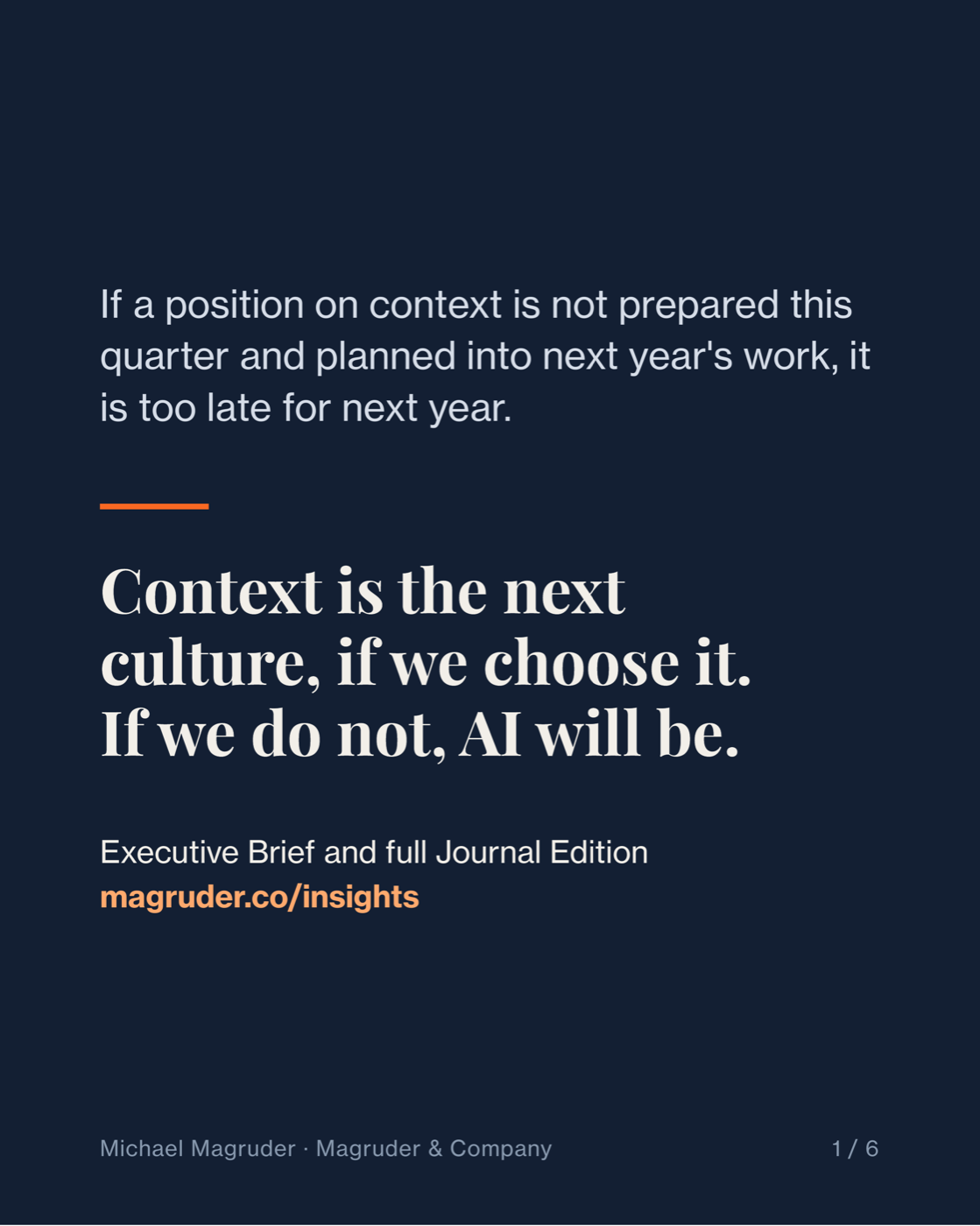
“If a position on context is not prepared this quarter and planned into next year's work, it is too late for next year. Context is the next culture, if we choose it. If we do not, AI will be.”

Why context, not workflow automation, is the true anchor around which enterprise culture forms, and what executive teams must do this quarter before AI absorbs the work.

250,000 Returned Hours
138 FTEs Capacity Created
1 Quarter Window of Action
Read Executive Brief → Includes Full Unabridged Journal Edition
Strategic Leadership & Executive Canon
PORTCO
The Q3 Reality Check for PE Platform CEOs: Surviving the 58% Turnover Trap and Hardening Your Value-Creation Plan Before October Board Reviews
Why Magruder & Company is opening sovereign access to strategy hardening, plan rebuilding, and boardroom defensibility before October board reviews commence.
→
CRUC
The Friday Crucible: Challenge Us With Your Single Most Critical Executive Constraint Entering Q4
Opening sovereign access to multi-model governance, Customer Core, and proprietary decision models for leadership teams needing hardened strategy memos by Friday 5:00 PM or Monday 8:00 AM.
→
PE
The Operating Partner's Q3 Reality Check: Stress-Testing PortCo Value Creation Plans in Five Days
How private equity sponsors and platform CEOs stress-test Value-Creation Plans in five business days before Q4 board reviews, surviving the 58% 24-month executive turnover trap.
→
ELT
Executive Fluency & Strategic Clarity at the ELT Table
Why artificial intelligence fluency and strategic clarity are non-negotiable executive outcomes. Eliminating superficial buzzword mimicry and establishing unified C-suite posture.
→
LEAD
The Executive Governed AI Manifest: Enterprise AI Governance, Liability Boundaries, and Board-Level Accountability
The Board and Audit Committee will ask the CEO who owns AI risk. How leadership establishes the Three Analog Invariants (Navigation, Memory, Enforcement), bounds autonomous agency, and maintains Delaware Caremark fiduciary oversight before annual operating plans harden.
→
RSCH
The Record Is Not the Memory: Why the Summary Is Never Evidence in Enterprise AI
Enterprises deploying AI on lossy summaries or unverified retrieval pipelines accumulate invisible liabilities. When regulators or audit committees ask for provenance, summaries cannot prove what actually occurred.
→
ARCH
The Five Crises of Modern Enterprise AI Governance
88% of enterprises deploy AI, yet 81% report zero bottom-line gain. An empirical deconstruction of the structural mismatch destroying enterprise AI value.
→
Quarterly Analysis
Q3
The Q3 AI Budget Trap
Why organizations are funding transformation before building the foundation, and what to do before Q3 budget decisions close.
→
Q2
The Q2 Imperative: Why AI-Preparedness Is Not Optional
The case for AI preparedness as an execution problem, not a strategy problem. 95% of companies fail to achieve measurable financial impact from generative AI.
→
Five Constraints Series

A diagnostic series mapping the five organizational constraints that block AI-preparedness before a single dollar of AI investment is made.

01
The Board Deck Is Not a Strategy
Why the AI slide in your board deck does not constitute a strategy, and what the distinction costs when implementation begins.
→
02
Competence Theater
82% of companies provide AI training; 59% still report a skills gap. The credential is not the capability.
→
03
Why Your AI Program Cannot Account for Itself
78% of executives cannot pass an independent AI governance audit within 90 days. The accountability vacuum hiding inside most AI programs.
→
04
The AI Budget You Don’t Know You Have
The invisible AI spend most organizations are already making, and the governance decisions that determine whether it compounds or dissipates.
→
05
Nobody Owns the AI Failure, and You Are Paying for It
When 59% of IT claims ownership of AI outcomes and 61% of Operations makes the same claim simultaneously, the accountability vacuum is structural.
→
Manufacturing Series

A four-part series for CFOs and CTOs on the architectural and workforce decisions that determine competitive position in AI-integrated manufacturing before 2030.

01
The 2030 Decision Window: A Manufacturing Agenda for CFOs and CTOs
58% of enterprises are deploying physical AI. Only 16% are hitting their targets. The architectural commitments that close that gap will largely be made in the next four years.
→
02
The Balance Sheet of IT/OT Convergence: The CFO’s 2030 Deadline
IT/OT convergence is the foundational decision behind every AI initiative in manufacturing. The CFO case for starting before the urgency becomes obvious.
→
03
The Workforce Gap No One Is Budgeting For: Why 2030 Is the Deadline
Factory operations will be 54% AI-augmented by 2030. The workforce investment to make it work is the gap most manufacturing organizations are not treating as a deadline.
→
04
IT and OT: The Merge Can’t Wait
IT and OT operated as separate domains for most of manufacturing history. The infrastructure required for AI at scale requires convergence that takes years to build. 2030 is four years away.
→