Across the modern corporate landscape, billions of dollars of enterprise value are being squandered not through a failure of technology, but through an unprecedented collapse in executive comprehension and governance.
"This is where fluency and clarity are outcomes required by our leaders today, especially at the ELT."Michael Magruder, Founder & Sole Principal
The Executive Leadership Team (ELT) does not need to learn how to write PyTorch code, fine-tune neural weights, or construct vector indexes. However, the ELT can no longer hide behind superficial slogans, vendor-scripted slide decks, or the dangerous abdication of delegating artificial intelligence to the IT department.
Artificial intelligence is not an IT infrastructure upgrade. It is an enterprise capital allocation transformation, an operating model restructuring, an unprecedented legal and contractual liability surface, and a fundamental strategic posture decision.
To steer the enterprise through this crucible, leadership teams require two distinct, non-negotiable outcomes:
- True Executive Fluency: The mechanical comprehension of artificial intelligence translated directly into business risk, margin structure, contract liability, and capital allocation.
- Sovereign Strategic Clarity: An unshakeable corporate position, unified leadership alignment, disciplined hurdle rates, and unambiguous operating boundaries where every C-suite officer speaks with a single, authoritative voice.
1. The Core Thesis: Fluency and Clarity as Non-Negotiable Outcomes
Modern enterprise leadership sits between two destructive extremes: the credulous adoption of vendor hype on one side, and reactionary paralysis on the other. Resolving this crisis requires deconstructing the difference between superficial mimicry and true fluency, and between fragmented experimentation and strategic clarity.
1.1 Superficial Buzzword Mimicry vs. True Executive Fluency
The prevailing dynamic in most Fortune 1000 and private equity portfolio boardrooms is the "Emperor's New Clothes" Vulnerability:
| Dimension | Superficial Buzzword Mimicry (The Vulnerability) | True Executive Fluency (The MCo Standard) |
|---|---|---|
| Linguistic Profile | Regurgitates commercial vendor slogans: "agent swarms", "enterprise RAG", "copilots", "autonomous intelligence", and "generative transformation." | Speaks in grounded operational mechanisms: stochastic distribution, context window attention limits, deterministic state engines, and sovereign memory substrates. |
| Depth Under Interrogation | Collapses two questions deep. Unable to explain why models hallucinate math, how data leaks occur in multi-tenant clouds, or why context expansion degrades precision. | Explains the exact mechanical boundary: why probabilistic models cannot perform balance sheet math, where negative-space blindness lurks, and how token unit economics dictate margin impact. |
| Vendor Relationship | Passive buyer. Accepts vendor marketing claims, signs unvetted per-seat SaaS copilot licenses, and becomes locked into proprietary, rent-seeking API ecosystems. | Sovereign interrogator. Demands verifiable benchmarks, enforces zero-data-retention terms, calculates true cost per completed task, and decouples corporate memory from third-party weights. |
| Organizational Impact | Breeds internal cynicism. Front-line engineers and middle management recognize executive ignorance, resulting in passive resistance, shadow tool adoption, and cultural fatigue. | Instills institutional authority. Technical teams respect leadership boundaries; operating units align around clear, verifiable constraints; capital allocation is respected. |
| Fiduciary Posture | Abdication. Treats AI as an "IT experiment" delegated to the CIO or CTO, ignoring enterprise liability, margin compression, and strategic posture. | Governance. Treats AI as an enterprise capital allocation, legal liability, and strategic defensibility mandate directly owned by the CEO and Board. |
1.2 Paralysis and Fragmented Experimentation vs. Sovereign Strategic Clarity
| Dimension | Paralysis & Fragmented Experimentation | Sovereign Strategic Clarity |
|---|---|---|
| Initiative Structure | Dozens of disconnected departmental pilots, uncoordinated trial licenses, duplicative proof-of-concept projects, and conflicting vendor agreements. | A disciplined, prioritized roadmap focused exclusively on 1 to 3 sovereign operational bottlenecks that unlock measurable enterprise value. |
| Capital Allocation | Unmetered operational expenses: escalating SaaS seat fees, untracked API consumption, hidden integration overhead, and unquantifiable consultant billing. | Private-equity-grade hurdle rates: mandatory 3.0x net cash ROI within 12 months, or verifiable EBITDA expansion equal to at least 2.5x total implementation cost. |
| Cross-Functional Cohesion | Complete dissonance. The CEO envisions transformation, the CFO freezes budgets, the GC circulates restrictive memos, and sales reps paste customer data into public web tools. | Total alignment. CEO, CFO, COO, CRO, GC, CHRO, and CTO operate from a single, ratified Corporate AI Position Charter with unified public and internal narratives. |
| Operational Boundaries | Vague guidelines, unenforced acceptable-use policies, and widespread shadow-AI usage across the workforce. | Programmatically enforced boundary invariants: zero LLM math, mandatory human maker-checker sign-offs, and sovereign enclave data protections. |
| Enterprise Valuation Impact | Ephemeral, commoditized software overhead that adds zero multiple expansion and creates balance sheet friction during transaction diligence. | Sovereign intellectual property: proprietary corporate memory substrates, codified operational heuristics, and protected data assets that expand exit multiples. |
2. The ELT Fluency and Clarity Diagnostic Matrix (The 5x5 Scorecard)
To evaluate, diagnose, and elevate an Executive Leadership Team from superficial confusion to institutional governance, Magruder & Company deploys the 5x5 ELT Diagnostic Matrix:
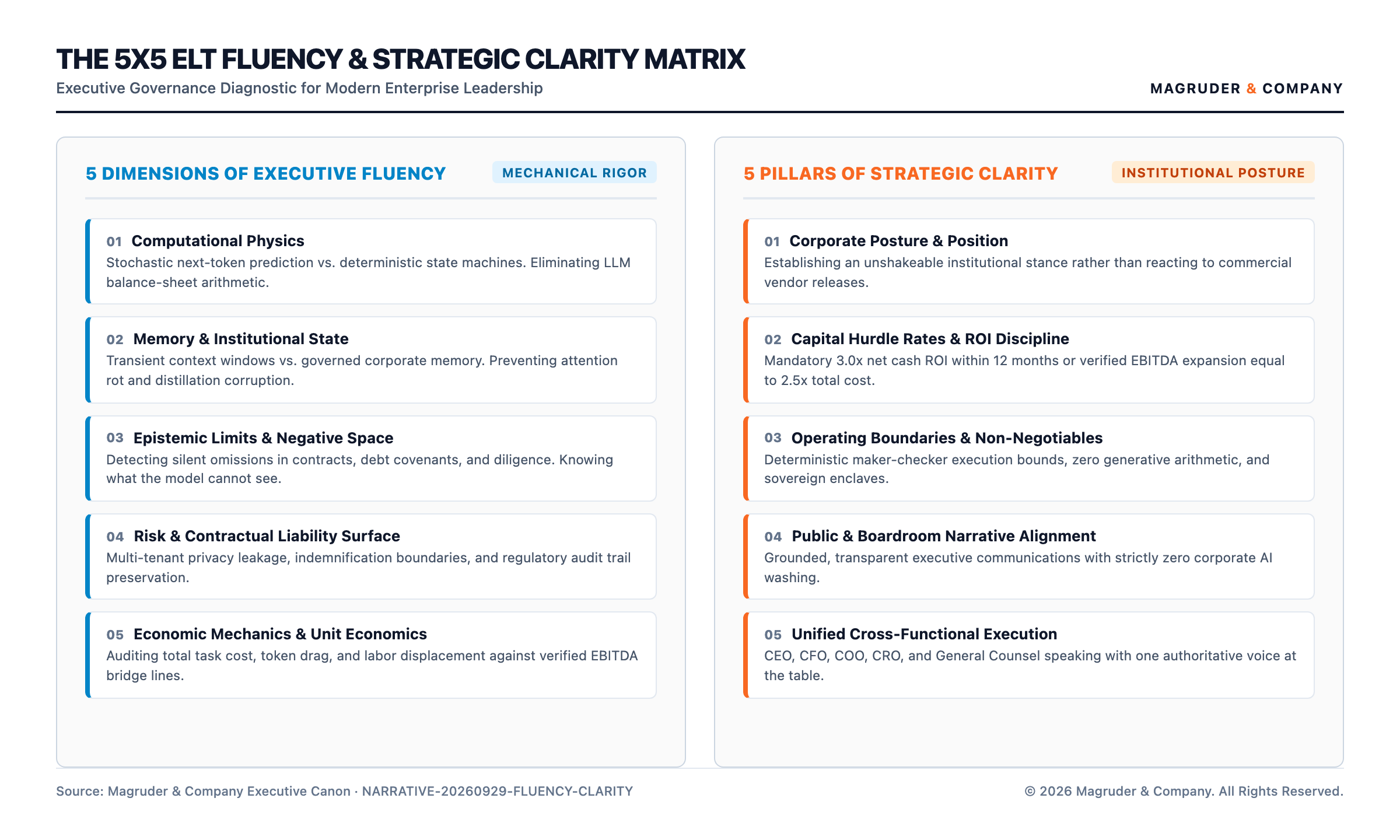
The 5 Dimensions of Executive Fluency
Dimension 1: Computational Physics (Stochastic vs. Deterministic)
Generative language models do not calculate or reason: they predict the most probable sequence of following tokens based on statistical training distributions. They possess no internal logic engine, no concept of mathematical truth, and no balance sheet reconciliation mechanism. Generative models are exceptional drafting, synthesizing, and semantic classification tools: they are completely unsuited for arithmetic, financial accounting, inventory reconciliation, or programmatic decision gating.
Dimension 2: Memory & Institutional State (Context Windows vs. Governed Memory)
Frontier model providers market massive context windows (1M to 2M tokens) as a substitute for institutional memory. In computational reality, massive context windows suffer from severe attention degradation (lost-in-the-middle syndrome), quadratic compute latency, and semantic dilution. Dumping an entire document repository into an active prompt does not constitute institutional state. True institutional memory requires structured, partitioned, on-device corporate memory substrates that store validated heuristics in atomic solution units.
Dimension 3: Epistemic Limits & Negative Space (What the Model Cannot See)
Generative models operate exclusively on the text placed before them. They are structurally blind to "negative space": what has been omitted, excluded, unexpressed, or concealed. A model will summarize a 100-page contract with complete grammatical fidelity while failing to notice that the standard liability cap or environmental indemnity clause is entirely missing. AI cannot be trusted as an independent auditor without structured negative-space interrogation protocols.
Dimension 4: Risk & Contractual Liability Surface
Multi-tenant commercial frontier APIs and web interfaces routinely log, cache, or inspect user prompts. Even with commercial privacy toggles, standard terms of service frequently retain prompt metadata, permit employee safety audits, and disclaim substantive indemnification for IP infringement or data loss. Every unvetted prompt submitted by an employee constitutes a potential breach of client confidentiality or an irrevocable forfeiture of trade secret protection.
Dimension 5: Economic Mechanics & Unit Economics
The cost of AI is not measured by the monthly per-seat SaaS fee. True operational cost is dictated by token throughput, model reasoning overhead, latency cascades, prompt maintenance, human-in-the-loop verification labor, and technical debt accumulation. An automated workflow that costs $0.02 per query in raw API tokens may cost $45.00 in human verification, error correction, and downstream exception handling when the model produces edge-case failures.
The 5 Pillars of Strategic Clarity
| Pillar | Strategic Mandate | The Clarity Standard |
|---|---|---|
| Pillar 1: Corporate Posture & Position | Explicit institutional choice: Frontier Aggressor, Sovereign Fast-Follower, or Air-Gapped Fortress. | Ratified in the Corporate AI Position Charter. Department heads are barred from pursuing projects that conflict with the chosen posture. |
| Pillar 2: Capital Hurdle Rates & ROI | Mandatory 3.0x net cash ROI within 12 months, or verifiable EBITDA expansion equal to at least 2.5x total cost. | Every initiative must identify the specific operational bottleneck it eliminates, the exact hours of labor reallocated, and net compute cost. |
| Pillar 3: Operating Boundaries | Zero LLM math; mandatory human maker-checker sign-offs; asymmetric fail-closed execution. | Hardcoded into technical architecture and written into company employment, security, and vendor policies. |
| Pillar 4: Public & Boardroom Narrative | Grounded, transparent executive communications across 5 Audiences: Board, Investors, Customers, Workforce, Regulators. | Strict elimination of promotional hype and corporate AI washing across all shareholder letters, sales collateral, and filings. |
| Pillar 5: Cross-Functional Alignment | CEO, CFO, COO, CRO, GC, CHRO, and CTO speaking with one authoritative voice. | When questioned individually by board members or auditors, every C-suite officer articulates the identical corporate position and boundary conditions. |
3. The "Wrapped Context" Architecture
The fatal flaw of conventional technical education is that it attempts to teach executives abstract computer science: matrix multiplication, backpropagation algorithms, vector mathematics, and transformer attention formulas. Executives glaze over, retain nothing, and retreat into buzzwords.
The fatal flaw of conventional management consulting is that it provides high-level 2x2 matrices completely detached from how software actually works.
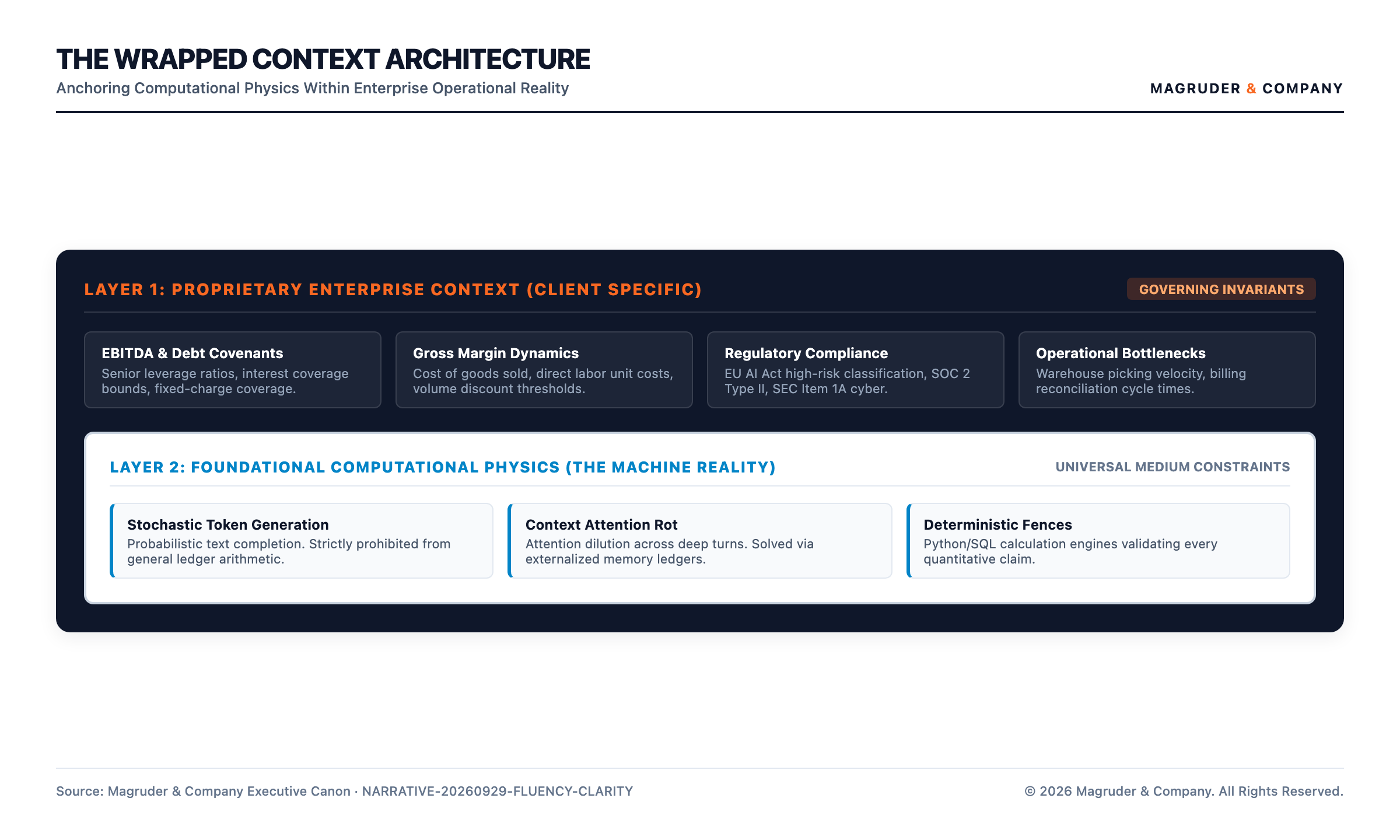
Michael Magruder's Wrapped Context Architecture resolves both failures by taking foundational computational mechanics and wrapping them directly around the client's proprietary commercial, financial, and operational reality:
4. The Boardroom Command Center & The "One Friday Constraint"
Strategic clarity cannot be forged over months of committee meetings and meandering steering sessions. Alignment must be forged under live executive debate with all principals in the room, facing the same facts, and resolving trade-offs in real time.
Magruder & Company delivers this through the "One Friday Constraint": a single, intensive 6-hour executive committee alignment engagement driven by the Boardroom Command Center.
The 4-Module Alignment Arc
- Module 1: The Epistemic Deconstruction (90 Minutes): Live "Buzzword Audit" surfacing contradictory internal definitions, followed by live empirical demonstrations of arithmetic failure, sycophantic bias confirmation, and negative-space omission blindness on the room's displays.
- Module 2: The Functional Alignment Audit (120 Minutes): Socratic interrogation of each seat at the table (CEO, CFO, COO, CRO, GC, CHRO, CTO), exposing hidden trade-offs between commercial velocity and contractual liability.
- Module 3: Defining Enterprise Posture & Corporate Position (90 Minutes): The leadership team formally selects its posture and drafts its explicit stance across the 5 Critical Audiences.
- Module 4: Inscribing Governance Invariants & Ratification (60 Minutes): Consensus is translated into formal, programmatic execution invariants and the team executes the binding Corporate AI Position & Posture Charter.
5. Measurable Governance Exit Criteria
In accordance with our governance standard, Magruder & Company enforces strict, quantifiable exit criteria for establishing executive fluency and strategic clarity:
| Metric / Standard | Pre-Engagement Baseline | Post-Engagement Exit Threshold |
|---|---|---|
| 1. Executive Fluency Score (EFS) | Average: 24% to 36% | Minimum: >= 85.0% across all C-suite seats |
| 2. Strategic Clarity Score (SCS) | Average: 18% to 32% | Minimum: >= 90.0% across all C-suite seats |
| 3. Buzzword Density Index | > 12 unanchored slogans per 1,000 words | Exactly 0 unanchored marketing slogans |
| 4. Cross-Functional Cohesion | Disconnected departmental silos | 100% unanimous signed charter ratification |
| 5. Capital Hurdle Rate Binding | Ad-hoc / unmetered experimental spend | 100% adherence to verified 3.0x ROI standard |
| 6. Boundary Invariant Enforcement | Unwritten / routinely bypassed | Cryptographic, machine-enforced boundary checks |