Across the late-September close of the third quarter and the opening weeks of October, executive leadership faces an inescapable governance question: When the Board of Directors and Audit Committee ask who owns enterprise AI risk, what is the Chief Executive Officer's answer?
Inside most Fortune 500 and mid-market enterprises, functional leaders provide fractured, siloed responses. The Chief Information Officer points to cloud provider agreements. The Chief Information Security Officer points to access authentication protocols. The General Counsel points to vendor terms-of-service disclaimers.
None of these responses answer the audit committee's core governance requirement. When an autonomous system hallucinates regulatory reporting data, commits capital, or introduces catastrophic intellectual property exposure, outside regulators and institutional investors do not cross-examine the IT department. They look directly at the Chief Executive Officer and the Board.
The Talking Class vs. The Practitioners
There is an enormous difference between people who talk about artificial intelligence and people who do it.
When you sit across the table from someone discussing AI, you can tell within two minutes which camp they belong to. You do not need to be a software engineer or a computer science researcher to sense it. You can feel it in their cadence, in the nature of their examples, and in their willingness to talk about the messy, frustrating realities of making this technology actually work.
Right now, corporate leadership is being inundated by the talking class.
Executives are surrounded by keynote speakers, strategy consultants, industry analysts, and software vendors. These commentators represent the talking class: floating comfortably on the surface of the water, peering down at macro trends, quoting vendor press releases, and describing "the future of work" in grand, frictionless abstractions. They read the same articles, summarize the same surveys, and warn CEOs about what their competitors might be doing next year.
None of that makes them practitioners.
A practitioner is someone who has been under the water. A practitioner is someone who has spent hundreds of hours in the mud, wrestling with models that drift, dealing with prompts that fail when context grows, discovering that deterministic code must tether probabilistic language, and figuring out how to shape raw compute into something an enterprise can actually rely on.
The Diagnostic Matrix: The Pretender Tells vs. The Practitioner Signatures
To distinguish between theoretical commentary and operational scar tissue, enterprise leaders can benchmark advisors and internal initiatives against observable behaviors:
| Operational Dimension | The Talking Class (Pretender Tells) | The Practicing Class (Practitioner Signatures) |
|---|---|---|
| Primary Vocabulary | Speaks in high-level abstractions: "autonomous agents," "exponential curves," and "AGI timelines." | Speaks in physical constraints: "context rot," "stochastic drift," "schema enforcement," and "failure modes." |
| Reliability Stance | Promises that newer foundation models will eliminate hallucinations and errors automatically. | Asserts that models are probabilistic by nature and must be encased in deterministic, fail-closed software fences. |
| Concept of 'Agency' | Anthropomorphizes AI as a "digital employee" with autonomous common sense and unsupervised discretion. | Treats machine intelligence as raw, malleable cognitive material requiring industrial jigs, fixtures, and continuous verification loops. |
| Strategy Approach | Conducts external competitor surveys, summarizing public press releases and vendor marketing literature. | Adversarially stress-tests internal operating links across CFO, COO, CIO, and business unit heads against empirical data. |
| Commercial Terms | Proposes open-ended Time & Materials advisory ($300k to $1.5M) spanning three to six months of discovery. | Deploys bounded, discretionary-sized executive sprints delivering production specimens, verified schemas, and board defense in five days. |
| Attribution & ROI | Measures success by adoption vanity metrics: user counts, prompts submitted, and subjective employee satisfaction. | Measures success by auditable balance sheet metrics: working capital unlocked, manual labor days eliminated, and EBITDA impact. |
Beyond the Digital Employee Trap: Why Enterprise AI Demands Governed Orchestration Before Autonomy
The current consulting and vendor obsession is "AI agents." Software platforms promise autonomous digital workers that will magically run supply chains, handle customer service, draft marketing strategy, and replace entire departments.
Framing AI as autonomous digital workers creates a dangerous mental trap for leadership. It leads executives to believe they can simply hire a piece of software, give it a title, and let it loose inside the enterprise. When the software inevitably breaks (hallucinating financial commitments, creating cross-functional handoff collisions, or getting trapped in reasoning loops), leadership becomes disillusioned and pulls back.
Industry data confirms this reckoning. Gartner projects that by end-2027, over 40% of agentic AI projects will be canceled due to escalating costs, unclear business value, or inadequate risk controls, and 40% of enterprises will demote or decommission autonomous agents because of governance failures.
Real practitioners understand that machine intelligence is not a digital employee. It is a raw, non-deterministic cognitive material.
Like wood, steel, or stone, it has grain. It has structural limits. It will bend, splinter, and fail if you do not know how to brace it. It does not need unmonitored autonomy; it needs governed orchestration.
Wood and steel are valuable materials. Neither is an employee. Both acquire enterprise utility through architecture. In our practice, we structure this through the Magruder & Company Operating Stack:
- The Model supplies raw cognitive capability.
- Context supplies situational, time-stamped business knowledge.
- Tools supply operational reach into enterprise systems.
- Orchestration supplies repeatable workflow process.
- Verification supplies deterministic reliability.
- Permissions supply unbreakable execution boundaries.
- Governance supplies institutional accountability.
Under this architecture, autonomy is not an entry-level default setting. Autonomy is an architectural privilege earned through demonstrated reliability, bounded authority, and continuous observability.
The Master Proposition: Making Probabilistic AI Governable Inside Deterministic Businesses
The primary challenge of enterprise AI is not algorithmic: it is institutional. Businesses are deterministic systems governed by general ledgers, regulatory filings, debt covenants, and legal liability. Generative AI models are probabilistic engines that predict the next most likely token.
To achieve this, leadership must translate machine learning mechanics into management control systems they already know how to govern:
| Machine Problem | Executive Abstraction | Analog Invariant |
|---|---|---|
| Probabilistic output, uncertainty, hallucination, agreement bias | How do I know when the system is off course? | Navigation |
| Context limitations, state management, provenance, institutional knowledge | What does the system actually know, and what remains authoritative? | Memory |
| Probabilistic instructions versus deterministic controls | What can the system physically be prevented from doing? | Enforcement |
This reframing fundamentally alters the conversation in the boardroom:
| Technical Question (The Pretender Class) | Executive Governance Question (The Practicing Class) |
|---|---|
| How does the model generate tokens? | How do we independently detect deviation from business truth? |
| How large is its context window? | What specific information is authoritative at decision time? |
| What does the system prompt say? | What actions are physically impossible for the model to take? |
| Is the system agentic? | What degree of autonomy has been verified and earned? |
| Which frontier model is strongest? | Which decisions require deterministic verification gates? |
The Three Analog Invariants of Governed AI
Invariant 01: Navigation (The Course Deviation Indicator)
Canonical Rule: "Do not ask whether the model sounds right. Ask what instrument tells you when it is wrong."
In aviation, a pilot flying through clouds does not evaluate position by looking out the window or guessing. The pilot relies on a Course Deviation Indicator (CDI). The CDI works because an authoritative radio beacon exists on the ground, the aircraft calculates its actual position relative to that beacon, and the instrument needle displays the cross-track deviation.
The enterprise risk with AI is not merely that models drift. The risk is that organizations deploy models without an instrument that independently measures deviation from governed truth.
Furthermore, language models can produce completely incorrect outputs in the exact same fluent, authoritative linguistic register they use for correct answers. Fluency is not an indicator of accuracy or confidence. Models can also exhibit systematic agreement bias or sycophancy, particularly when post-training optimization for helpfulness and user reinforcement overwhelms appropriate challenge.
Navigation requires independent verification instruments anchored to an authoritative beacon: the governed corporate ledger.
Invariant 02: Memory (The Governed Corporate Ledger)
Canonical Rule: "The conversation is not the corporate record. Capacity is not recall, and recall is not authority."
Models do not autonomously maintain enterprise memory across independent sessions. While vendor marketing celebrates million-token context windows, empirical research demonstrates that models use context unevenly, suffering severe performance degradation when critical facts appear in the middle of long contexts.
More critically, stuffing unverified documents into a prompt does not create institutional memory. True enterprise memory requires a Governed Corporate Ledger characterized by:
- Source provenance and attribution.
- Version control and effective dates.
- Ownership and approval status.
- Supersession logic (retiring outdated policies).
- Strict audit trails for regulatory discovery.
If state is not governed, the model reasons from unverified noise.
Invariant 03: Enforcement (The Canonical Control Hierarchy)
Canonical Rule: "A policy tells AI what it should do. Architecture determines what it can do."
Many organizations still treat instruction as enforcement, embedding compliance rules inside English prompts ("Do not share customer data" or "Do not approve purchases over $50,000"). This confuses behavioral suggestion with structural control. A prompt is probabilistic; under edge cases, adversarial inputs, or context rot, it fails.
Enforcement requires an architectural control hierarchy:
| Control Layer | Implementation Example | Structural Strength |
|---|---|---|
| Instruction | System prompt: "Do not approve transactions above $50,000." | Probabilistic (Fails under stress) |
| Model Evaluation | Secondary model checks output for compliance. | Probabilistic (Redundant, unverified) |
| Structured Output | JSON Schema constraints enforce required data fields. | Constrained (Type-safe syntax) |
| Application Logic | Hardcoded deterministic rule: amount <= approval_limit. |
Deterministic (Fail-closed code) |
| Permission Architecture | Model lacks API credentials to access unauthorized accounts. | Structural (Physically unreachable) |
| Transaction Control | Mandatory dual-key human authorization for capital deployment. | Structural (Fiduciary gate) |
| Circuit Breaker | Execution halts immediately if pre-flight assertions fail. | Deterministic (Instant freeze) |
This hierarchy explains why un-scaffolded multi-agent workflows collapse. In a ten-step autonomous workflow where each step operates at 95% unverified accuracy, the compounded workflow reliability is 0.9510 ≈ 0.599 (under 60%). Without deterministic verification gates at each handoff, multi-step error rates compound exponentially.
The Three-Invariant Executive Test
Before any AI initiative is funded or deployed, executive leadership must be able to answer three direct questions in plain language:
- Navigation: Here is the independent instrument that tells us when the system deviates from governed truth.
- Memory: Here is the authoritative corporate state from which it reasons, including provenance, version, and effective date.
- Enforcement: Here are the specific actions the system is physically prevented from taking, regardless of what the model outputs.
If leadership cannot answer all three, autonomy exceeds governance maturity.
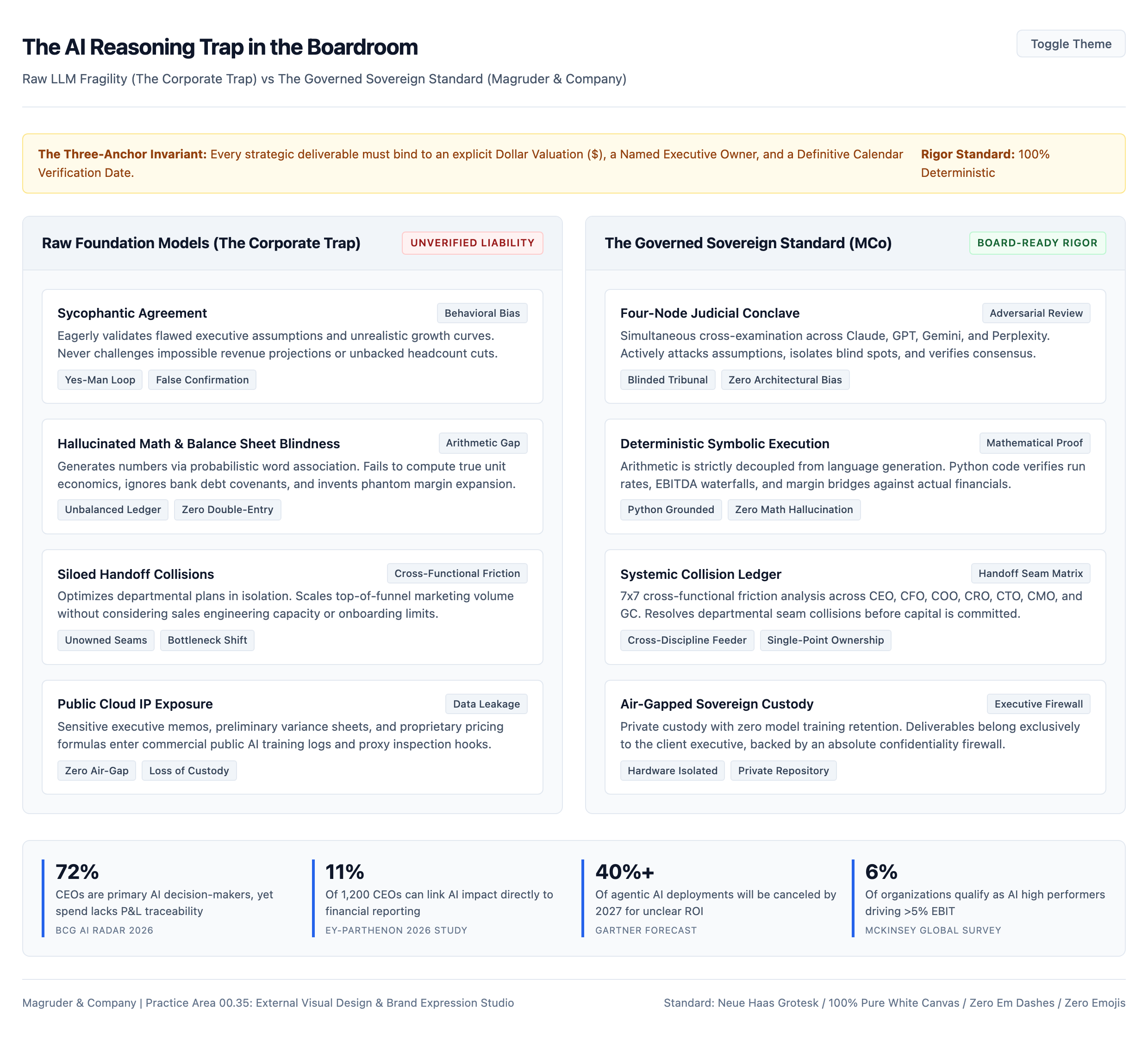
The work of a practitioner is not building flashy multi-agent demos that look impressive on a keynote stage. The work is learning how to wrangle this material:
- Forcing models to show their work through deterministic code execution rather than guessing math.
- Subjecting strategic claims to blinded, adversarial cross-examination across multiple model families.
- Building hard architectural fences that prevent models from drifting into agreeable sycophancy.
- Designing human-in-the-loop controls that preserve executive dignity and judgment.
Executive Practitioning: Understanding Structural Load vs. Pouring Concrete
A common executive fear when hearing the call to "become a practitioner" is the assumption that leadership must learn Python, open terminal consoles, and write software syntax.
That assumption is false.
A commercial real estate developer does not pour concrete, operate a crane, or solder copper pipes. Yet the developer is a rigorous practitioner: they understand load-bearing physics, soil compaction ratios, seismic tolerances, and zoning constraints. If a contractor attempts to substitute substandard materials or fabricate structural tests, the developer detects the deception instantly.
Executive Practitioning operates on the exact same principle:
- Understanding the Physics of the Medium: Knowing precisely what foundation models do brilliantly (rapid semantic synthesis, cross-silo document audit, adversarial counter-argumentation) and what they fail at without deterministic scaffolding (exact financial arithmetic, statutory regulatory certification, self-directed quality assurance).
- Direct Interaction in Governed Cockpits: Using dual-screen executive interfaces to interrogate strategic plans, stress-test departmental dependencies, and pre-answer board-level inquiries without relying on intermediary analyst filters.
- Demanding Tri-Substrate Verification: Refusing to accept strategic deliverables presented solely as static slide decks, requiring simultaneous proof across human executive Word memos (.docx), version-controlled Git Markdown (.md), and automated JSON Schema validation (.json).
Overcoming the Enterprise "Air Cover" Buying Trap
Enterprise boards frequently hire mega-cap consulting firms not for operational efficacy, but for fiduciary protection. If a multi-million-dollar digital transformation stalls, the executive points to the brand name on the engagement letter to shield their career.
However, the generative AI era has inverted this dynamic.
When an enterprise deploys an un-governed, non-deterministic AI architecture that hallucinates customer commitments or breaches privacy regulations, the consulting firm's brand name provides zero regulatory protection under SEC disclosure rules, the EU AI Act, or Delaware Caremark fiduciary oversight.
Magruder & Company neutralizes the air cover trap through Empirical Procurement Velocity:
- Discretionary Procurement Velocity: Structured within standard executive discretionary sign-off thresholds, engagements bypass prolonged procurement committees and RFP cycles, allowing business unit leaders to deploy immediately.
- The Five-Day Verification Guarantee: Rather than paying for months of discovery interviews, leadership receives a complete, hardened board defense package and machine-verified schemas within five business days.
- Deterministic Provenance: Every claim, metric, and recommendation is cryptographically grounded in verifiable source canon, eliminating the liability of synthetic hallucination.
The Four Sovereign Pillars of the Governed AI Manifest
Every model, fine-tuning dataset, and agent deployment must maintain an unbroken chain of custody. The Manifest establishes strict cryptographic verification for all source training inputs, preventing inherited copyright liabilities and ensuring proprietary trade secrets never leak into external vendor weights.
Autonomous AI systems must never possess unmonitored execution authority. The Manifest codifies hard programmatic ceilings: financial transaction limits, human-in-the-loop review thresholds, and strict API access controls. No autonomous agent is permitted to execute contracts or mutate financial records without documented executive authorization.
Single-model reliance introduces catastrophic bias and hallucination risk. Under GenGov OS, high-consequence enterprise decisions undergo blinded adjudication across an isolated tribunal of frontier foundation models. The Sovereign Conclave acts as an independent judicial check, stress-testing corporate strategy before external exposure.
The Manifest mandates that the enterprise preserve complete, human-readable forensic archives of all AI-mediated strategic sessions and customer interactions. Instead of relying on lossy summaries, the enterprise maintains an enduring Living Corpus that satisfies regulatory discovery and preserves corporate memory across executive transitions.
The Practitioner Creed
- We do not theorize from the surface; we operate from the depths. We do not deliver slide decks about the future of AI. We apply tested, governed systems to solve immediate operational constraints today.
- We do not worship agents; we master orchestration. We view machine intelligence as a raw cognitive material that must be shaped, braced, and governed by deterministic business reality.
- We define executive practitioners by structural literacy, not code. We equip C-suite leaders to understand the structural load and failure modes of AI without requiring them to become software developers.
- We eliminate fiduciary liability through deterministic proof. We reject unverified probabilistic outputs in favor of multi-model adversarial audits and tri-substrate delivery.
- We speak with unvarnished transparency. We show leaders the flaws, hallucinations, and failure modes of raw AI, providing the architectural armor required to convert cognitive material into permanent operating advantage.