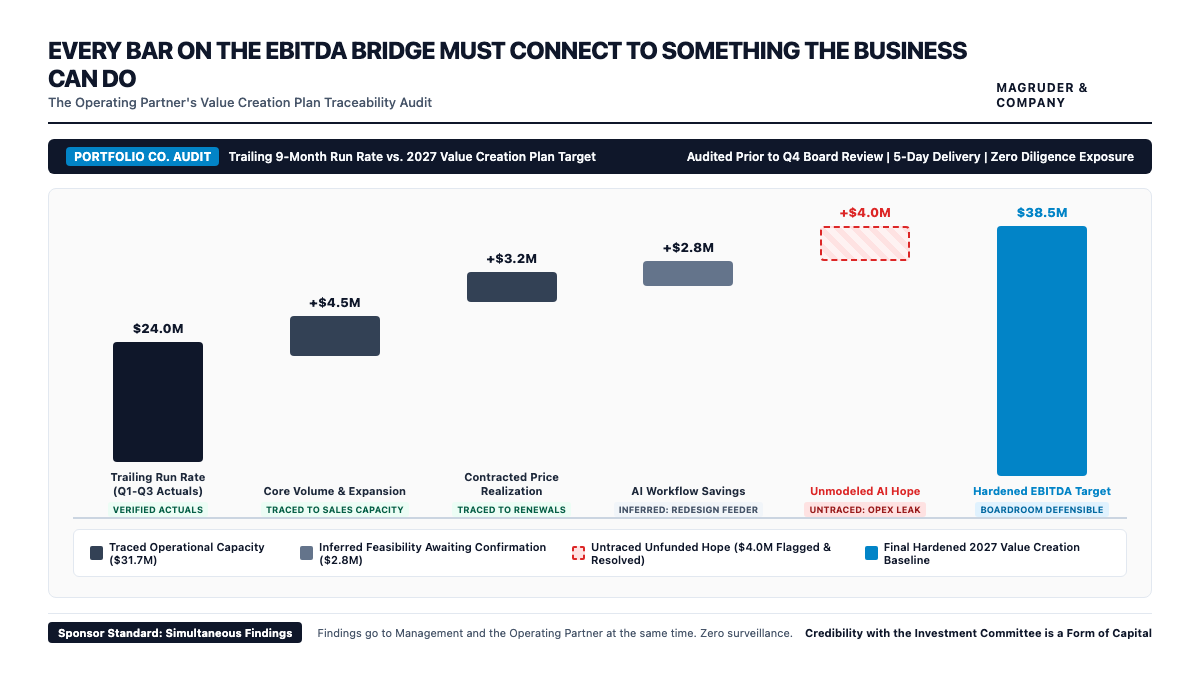
The Q4 board meeting for one of your portfolio companies is two weeks out. The management deck has arrived. The value creation slides show the plan on track, the AI initiatives on budget, and the fourth quarter carrying the year.
Then you open the monthly financials. The EBITDA run rate tells a different story.
Every Operating Partner has lived some version of this moment. What has changed is the cost of it. When a sponsor walks into a board meeting and defends a management narrative that the operating record does not support, the damage does not stay in the room. It travels directly into the next fundraising conversation with Limited Partners.
The Hold Clock Has Changed the Math
Bain & Company's Global Private Equity Report 2026 [1] counts roughly 32,000 unsold buyout portfolio companies holding about $3.8 trillion in unrealized net asset value. Distributions have fallen to roughly 14% of NAV: the lowest rate since 2008 and 2009. Buyout hold periods are stretching toward seven years.
Those figures describe a structural change in how value creation plans are judged. When a company was expected to exit in four or five years, a soft quarter could be absorbed by multiple expansion. When the hold runs toward seven years and exits trail historical backlogs, the value must be earned entirely in operating results. Each quarter of drift in the plan becomes a quarter of lost EBITDA that the eventual exit has to make up.
The Value Creation Plan was written at entry: under different interest rates, a different labor market, and in most cases before generative software entered the cost structure. Nine months into this year, it is fair to ask how much of that underwriting plan still describes the operational reality of the business.
Where PortCo Plans Break
1. The AI Spend Leak
BCG's AI Radar 2026 [3] found companies planning to lift AI spending from 0.8% to 1.7% of total revenue. McKinsey's global survey [4] found that only about 6% of organizations qualify as AI high performers, attributing 5% or more of EBIT directly to AI deployments.
At the portfolio company level, the gap between those two numbers usually looks the same. AI enters department by department: a sales tool here, a customer support agent there, a finance copilot for the monthly close. Each purchase is modest and each carries a plausible departmental case. Together they raise operating expense, while no single line in the EBITDA bridge shows where the return is meant to appear. The spending is real. The margin expansion is a slide.
2. The Finance Bottleneck
In Consero Global's 2026 CFO study of 102 investor-backed finance leaders [5], 45% of those surveyed reported spending more than 60% of their working hours on manual transactional operations, and keeping operations aligned with growth ranked as their leading operational risk concern.
This explains a pattern Operating Partners see repeatedly: the PortCo finance team closes the books on time and accurately, but lacks the bandwidth to test whether the sales plan, delivery capacity, headcount additions, and technology budget can all be true at once. The ledger is closed. The value creation plan is not.
3. The Fourth-Quarter Promise
When a portfolio company is behind plan at the end of Q3, the familiar response is to hold the full-year number and assign the entire variance to the final quarter. A sponsor who accepts that narrative in October owns it in January. The question an investment committee will eventually ask is the one the board must ask now: what changes in the fourth quarter that did not change in the third?
The Five-Day Sponsor Review Protocol
The purpose of this work is not to catch management out. It is to ensure that management and the sponsor walk into the board meeting holding the exact same set of audited facts.
An Operating Partner can apply this diagnostic to one to three portfolio companies, sequenced across the weeks leading up to their respective board meetings. For each company, the engagement letter names the client, and every finding goes to management and the Operating Partner at the same time. There are no side channels.
On Monday, the portfolio company hands over whatever exists: the draft board deck, monthly financials, the current Value Creation Plan, budget guidance, and a list of active technology and AI initiatives. Nothing needs to be cleaned or formatted. Management participates in two 30-minute conversations during the week. Everything else happens off the company's calendar.
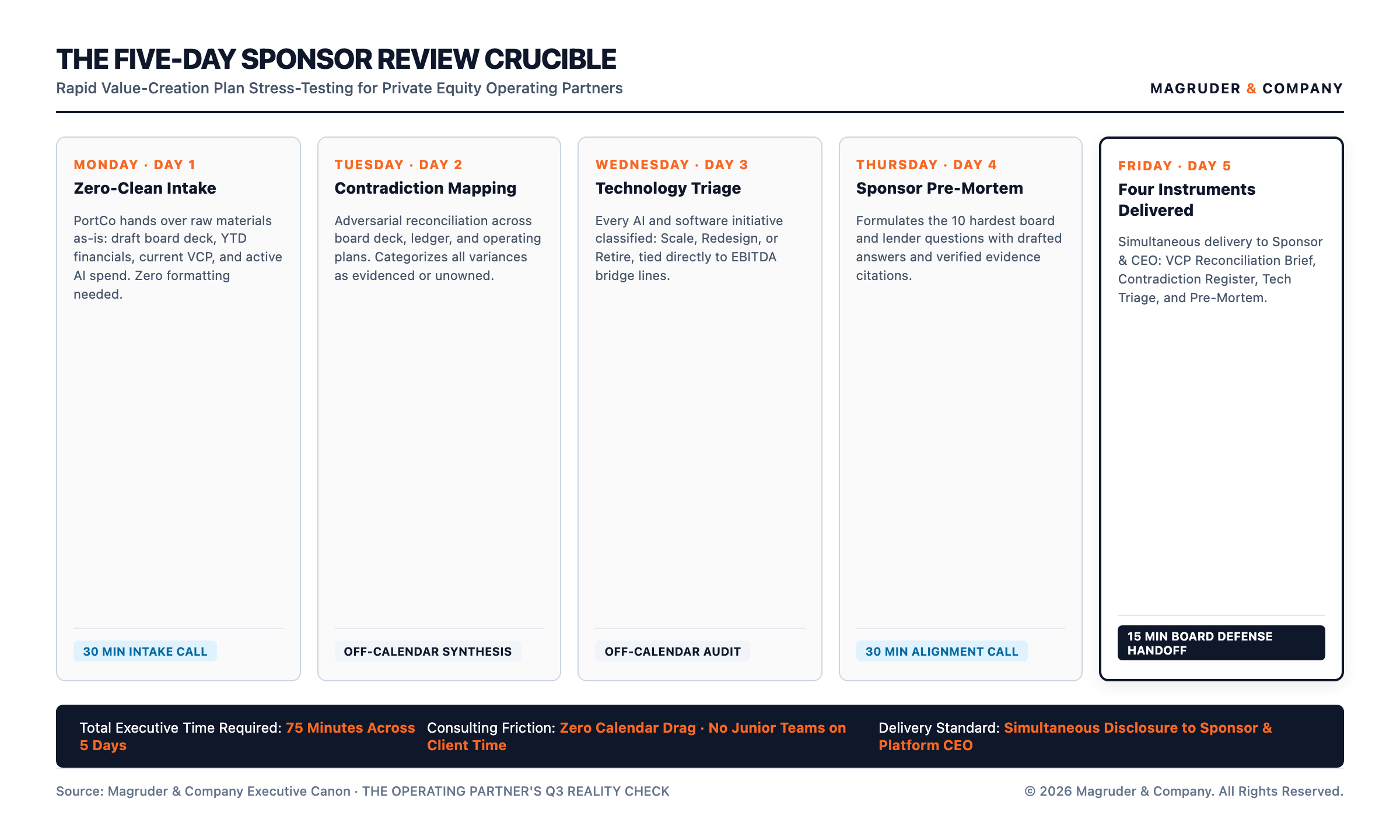
The Four Board-Defense Instruments Delivered by Friday
- The Value Creation Plan Reconciliation Brief: Each VCP lever set against year-to-date results, with the operational cause of every material variance. Each cause is marked as evidenced in company materials or inferred and awaiting confirmation.
- The PortCo Contradiction Register: Every point where the board deck, financials, and operating plan disagree, each assigned an owner, an operational status (reconciled, conflicting, or unowned), and the exact decision required to resolve it.
- The Technology and AI Spend Triage: Every software and AI initiative classified as Scale, Redesign, or Retire, accompanied by a definitive statement on whether it possesses a traceable path to EBITDA.
- The Ten-Question Sponsor Pre-Mortem: The ten hardest questions the board, investment committee, or lenders will ask. Each comes with a drafted answer, supporting evidence receipts, and a candid note wherever evidence is not yet established.
What "Hardened" Means for a Portfolio Company
A hardened plan is not a plan with zero problems. It is a plan whose problems are known, bounded, and owned by both management and the sponsor before they reach the board.
| Hardening Dimension | What the Test Audits and Produces |
|---|---|
| 1. Dependencies | Every cross-functional dependency in the plan is identified, owned, and marked as reconciled, conflicting, or unowned across leadership seats. |
| 2. Traceability | Every material operating assumption is traced to a named line in the EBITDA bridge, or explicitly flagged as untraced software overhead. |
| 3. Run Rate | Every forward Q4 target is benchmarked against trailing nine-month performance; any target exceeding run rate carries a documented operational rationale. |
| 4. Technology Spend | Every technology and AI line item is forensically categorized as Scale, Redesign, or Retire based on verifiable cash generation. |
| 5. Board Readiness | The ten most acute sponsor, lender, and auditor questions are anticipated and answered, backed by primary evidence receipts. |
What This Is Not
- It is not diligence or a quality-of-earnings review: It does not re-underwrite the acquisition or re-audit accounting books.
- It is not an assurance opinion: Management owns the plan and the narrative. The instruments provide management and sponsor a verified basis for both.
- It is not a replacement for the management team: It injects a week of senior practitioner synthesis at the exact moment management has the least bandwidth for it.
The Principal Standard
I spent the past year engineering this operating architecture and methodology. It is the exact standard I would demand before taking operating responsibility for a platform company: every lever traced to the bridge, every contradiction owned, every hard question answered before the board asks it. The tests, registers, and pre-mortem structures already exist: the five days apply that standard to a specific business.
At Magruder & Company, the same principal who speaks with management writes the instruments, tests the dependencies, and stands behind the result. No junior team learns the business on the portfolio company's time.
An Anchor for Management and Sponsor
The board review is the milestone, but the portfolio company executes every Monday morning.
This five-day diagnostic does not exist merely to prevent an awkward conversation with the investment committee. Its deeper purpose is to provide PortCo leadership and the Operating Partner with an operating anchor that is realistic, transparent, and covers all of the details.
When the functional disciplines represented at the PortCo executive table can see the entire business without the fog of departmental defense, they are empowered to create great choices. And having great choices is what allows leadership to make great decisions: knowing what operational trade-offs will protect the fourth-quarter EBITDA run rate, and refining what needs to happen in 2027 to reach the exit multiple the plan promised.